
The Paramount/Warner Bros. Deal (Part 1 of 4): The Billionaire's Heart Wants What the Billionaire's Heart Wants
Is Paramount's victory in its battle against Netflix a sign of Hollywood finally getting the kind of leadership needs? Or just the kind leadership it deserves?

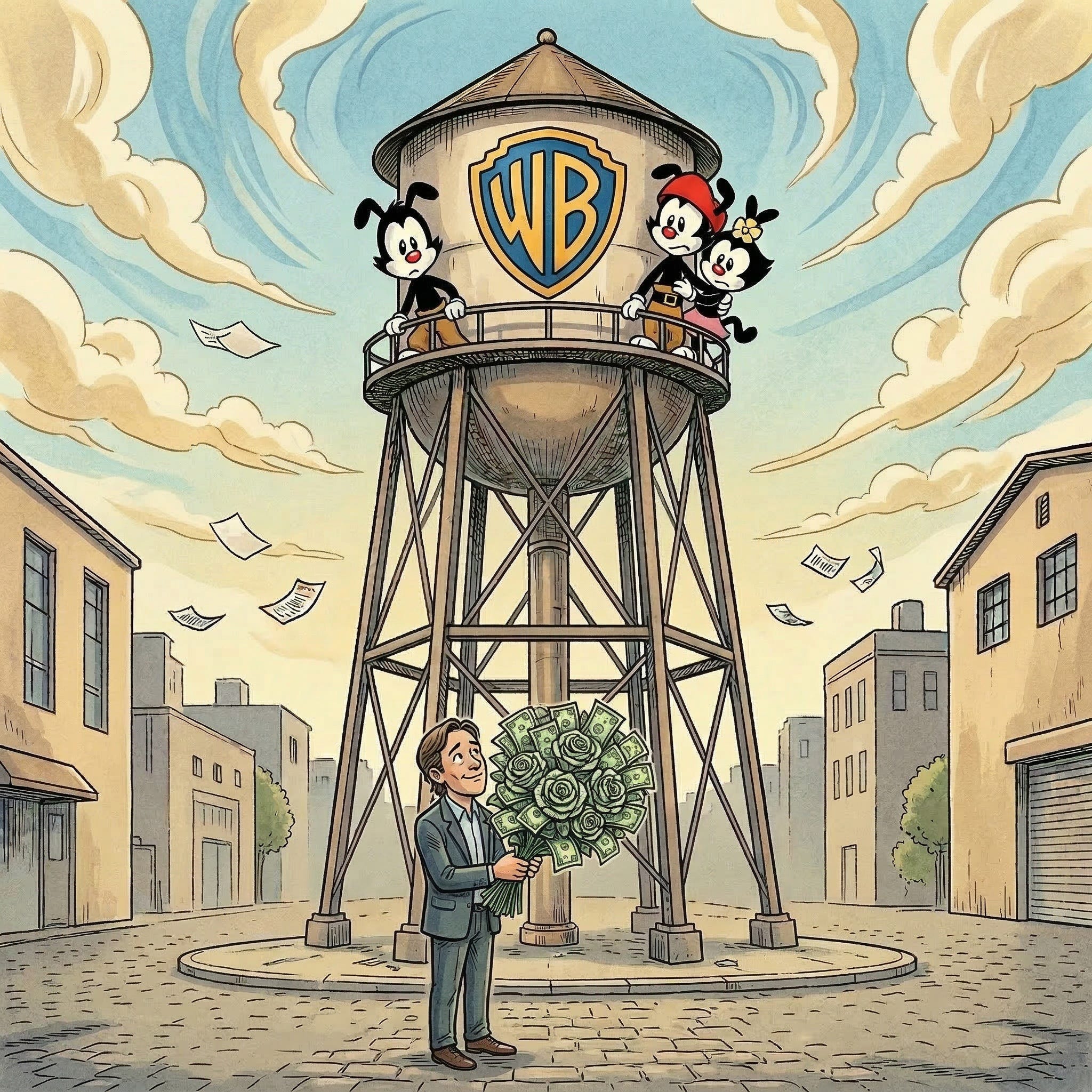
For months now, as Netflix and Paramount have competed for the privilege of wildly overpaying for Warner Bros., industry insiders have wondered and debated which deal would be “better” or “worse” for Hollywood as a whole, and which suitor would ultimately come out on top.
The first question is an extremely complex and nuanced one with no easy or obvious answer (though asking which would be “less bad” or “more bad” might be a more honest framing). Luckily, it’s now pretty much moot, because we seem to have our answer to the second: it’s the snowcapped mountain of Paramount, and not the big red “N” of Netflix, that current Warner Bros. employees can look forward to glaring at on the iconic WB water tower in Burbank.
At last! Now we can finally stop wasting our collective time speculating wildly about which company will get the deal, and start wasting our collective time speculating wildly about what will happen once it actually does (and how thoroughly the individuals and entities involved will have to prostrate themselves before Donald Trump to get there).
But there will be plenty of time for that later.
For The Business of Television Max(+)’s debut, I’ll be taking on the story that most of us are already talking about anyhow: Paramount’s victory in the most protracted and exasperating will-they-or-won’t-they corporate courtship since Skydance’s pursuit of Paramount just a few years ago. And to celebrate launch week, I’m making it a four-part series (after which I hope to never talk about this subject, or write another four-part series about any subject, ever again):
In today’s Part 1, I give a short answer to the question “Is this a good deal for Paramount?” (and a much longer answer to the question “Does it even matter?”).
In tomorrow’s Part 2, I’ll look at this deal in the context of Hollywood’s abysmal track record with mega-mergers, and consider what it will take for Ellison to succeed where so many others have failed.
In Wednesday’s Part 3, I will explain why this outcome is a win for Netflix — and how they managed to rig the situation so that pretty much any other outcome would have been too.
And finally, in Thursday’s Part 4, I’ll wrap up by exploring what this deal means for everyone else who didn’t have a seat at the bargaining table (and for one person who did).
Is This a Good Deal for Paramount?
No. It is definitely not a good deal. Or at least not by any conventional definition of a “good deal.”
To be clear, I’m not saying there isn’t sound logic behind David Ellison’s ambitious vision to combine these companies — there absolutely is. But a “good idea” can only make for a “good deal” if that deal is made at the right price. And there is no math in the world fuzzy enough to justify shelling out that amount of money (roughly $111 billion), or taking on that amount of debt (roughly $57.5 billion), for a prize that, this time last year, had a market capitalization of barely one-third of that amount (after years spent aggressively paying down its own crippling debt burden (which it was saddled with the last time the company was sold). Nor are there “efficiencies” enough to be found in all of Burbank, even for the most ruthless and bloodthirsty corporate consolidation consultant, to make the numbers work with layoffs alone.1
But all that just raises a more interesting (and troubling) question…
Does It Even Matter?
It’s hard for me to see this as anything other than a billionaire who is very accustomed to getting anything he wants deciding that what he wanted next was Warner Bros. (and that he would get it at any price).
I also suspect that the banks backing Paramount, as much confidence as they may have that Ellison’s gambit will unlock incredible value that will assure the repayment of that debt with ease, likely would not have signed up to loan that amount of money without Larry Ellison having agreed to personally guarantee most of the debt.
And all of this comes on the heels of a decade of traditional media companies mortgaging their own futures in a desperate struggle to keep up with the profligate spending of Netflix, Amazon, and Apple — all three of which effectively operate in a fundamentally different economic universe from their much smaller and less valuable legacy media rivals, and two of which are free from the pesky burden of having to run an actually profitable content business on a standalone basis.
“More than a few bad deals, panic moves, and generally shortsighted choices can be attributed to making sure there’s something good to talk about on next week’s quarterly earnings call and that this year’s bonuses pay out at target.”
Which raises perhaps an even more interesting (and even more troubling) question: maybe this is what Hollywood actually needs?2 Consider:
During the glory days of the studio system (from the early 1920s through the mid-1940s) — an era spanning The Jazz Singer, Irving Thalberg, Gone With the Wind, and Casablanca — the studios were largely under the control of powerful and wealthy3 moguls who, while careful to flatter, mollify, and entertain their investors,4 built the industry into an oligopoly in which they ran their companies as personal fiefdoms with sometimes dictatorial authority.5
After the decline and fall of the studio systems, throughout the New Hollywood of the 1960s and 1970s and during the resurgence of the major studios from the early 1980s into the mid-1990s — an era spanning Easy Rider, every single thing associated with Bob Evans, Star Wars, Indiana Jones, and Jurassic Park — the studios ran their businesses with relatively little interest or attention from the American financier class,6 often as plaything subsidiaries of much larger and more diversified corporate conglomerates.7
Starting around the late 1990s and into the 2000s — the same period over which the transformative force of the Internet (and the deep-pocketed megacompanies that it spawned) was unleashed upon the industry — the studios mostly operated as standalone or parent-level entities, growing increasingly accountable to (and thirsty for investment from) major institutional investors, first on Wall Street and later in Silicon Valley.
You can’t blame the disruption and destabilization of the entertainment industry over the last 15 years on any one thing, but don’t sleep on (1) the fundamental incompatibility of the entertainment industry (with its historically modest profit margins, modest growth curves, and immodest culture8) with the demands and expectations of the modern Wall Street/Silicon Valley investor class, or (2) the relentless willingness (incentivized and rewarded with maddening consistency) of many of the industry’s leaders to time and time again subordinate vision, leadership, and discipline to expedience, defensibility, and consistency with the calculation of one’s bonuses and/or equity incentives. More than a few bad deals, panic moves, and generally shortsighted choices can be attributed to making sure there’s something good to talk about on next week’s quarterly earnings call and that this year’s bonuses pay out at target. Ask the investors who gave us billion-dollar valuations for companies like Hello Sunshine, Spring Hill, and Agbo how those growth projections have worked out.9
So now, here we have David Ellison, who is pretty much making this deal not because he should but because he wants to and can, and whose pitch to lure top-level creative talent and content partners to the company (other than the checks with many zeroes on them) includes some version of the statement, “I’m the only CEO you can talk to in this town who is still going to be sitting in the same chair 10 years from now.”10
He’s probably right, and I can see why that boast, and the promise of continuity it implies, would be appealing to talent. In fact, it’s appealing to me: a chance for relief from a system that incentivized virtually every studio to go all-in on the same strategy, knowing that at best only half of them could succeed (and that the people responsible for the consequences would be well paid and long gone by the time those consequences were felt).11
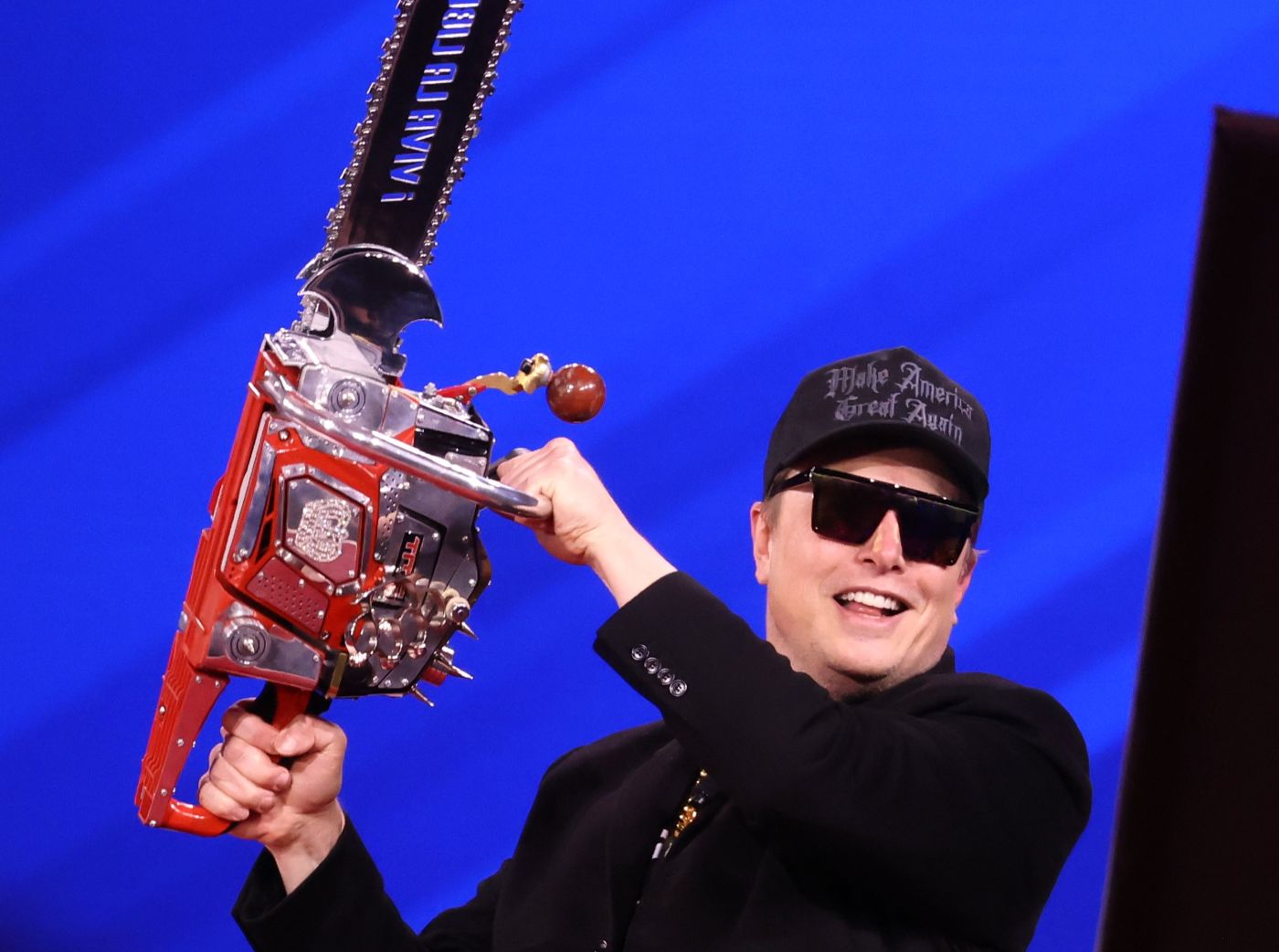
But the buzz fades when I remember that unaccountable billionaires can be a capricious bunch — after all, today’s techno-utopian climate warrior might be tomorrow’s chainsaw-wielding culture warrior. And it is all but lost when I remember the recent track record of deals like the one that Ellison just willed into existence.
Come back tomorrow for Part 2, in which I’ll explain why that track record should give even the most ambitious and unaccountable billionaire pause, and explore what it will take for Ellison to make his new mega-studio the exception to a frustratingly consistent rule.
Not to mention mind-boggling highly priced for people being hired to help the company maximize its cost savings. I sometimes wonder how many of the eliminated jobs it would take (especially among the lower-paid ranks) just to cover the consultants’ bills for any given merger. And now you might too! (Sorry.) Anyhow, we’ll get to the employees on Thursday.
If it pained and offended you to read that, please know that it pained and offended me to think it.
Albeit not wealthy enough to pay roughly the entire annual GDP of Ghana or Croatia to get what they want.
Initially mostly wealthy weirdos and private banks, and later the young New York investment banks (before they were fully institutionalized and woven, seemingly intractably, into the fabric of the economy and the entire financial system). And yes, I do mean entertain them with sexy parties.
And sometimes dictatorial ethics.
But with a comeback of the wealthy weirdos! (So yes, the sexy parties never went away.)
Columbia Pictures has been owned by global electronics giant Sony since 1989, when Sony acquired the studio from the Coca-Cola Company (which had owned it since 1982). Before Paramount was sold to Viacom in 1994 — only to be split from Viacom at the end of 2005, only to be recombined with Viacom at the end of 2019 — it was owned by Gulf + Western, a conglomerate whose primary business when it acquired Paramount in 1966 was manufacturing and resource extraction. NBCUniversal’s current owner, telecommunications giant Comcast, acquired a controlling interest in the company in 2011 (and full ownership in 2013) from once-mighty appliance giant General Electric. General Electric had owned NBC (via its parent company RCA Corp.) since 1986, and had acquired Universal from Canadian beverage company Seagram’s (which had owned the studio since 1996) in 2004. (And these companies’ executives, too, enjoyed the sexy parties.)
See, e.g., references to “sexy parties” above.
Yes, I know that those valuations are, if not simple exaggeration or misreporting, often smoke and mirrors based on hitting unattainable metrics and accomplishing unachievable goals. The point stands.
To be clear, I have not heard this pitch myself (or, for that matter, ever spoken to Ellison directly). But I have been told about it by people who I trust, who said they personally heard him make it, and I 100% believe them.
Perhaps driving another company Thelma and Louise-style toward a cliff, or simply retired to their estates.