

*** LIMITED TIME OFFER ***
Subscribe to The Business of Television Max before 11:59 p.m. PDT on March 31, 2026 to receive 50% off your first 12 months.
Promotional discount is available for both monthly and annual subscriptions, but does not apply to premium tier subscriptions (Max+), training/coaching/consulting services (Prime), or video game industry advisory services (1Up Productions). Lifetime subscription rate guarantee is based on the prevailing undiscounted price at the time of sign-up (currently $20/month or $200/year for Max or $500/year for Max+).
Navigation Bar Links for Substack App Users
Video Trainings (under construction)
What is The Business of Television Max?
Launched in March 2026, The Business of Television Max is a subscription-only companion to The Business of Television — a newsletter and information hub where you can find the latest and best information and authoritative analysis that I can offer about the TV and streaming industry (without waiting another five years for the next edition of the book to come out).
But more than that, it’s a place where working professionals at any stage of their careers can go to find unique advice, insight, and support to help them do their best work, and to make the most successful and rewarding careers they can for themselves — especially in these, uhh, let’s call them “deeply challenged and rapidly changing” times.
Aaaaaaand what is The Business of Television (and who are you) again?
Sometimes referred to as “the bible of the TV business” by executives, talent representatives, and creative professionals — only some of whom were actively and intentionally trying to flatter and manipulate the author at the time — The Business of Television is the leading reference guide to the TV and streaming industry for aspiring and working professionals.
That author is me, Ken Basin, a veteran business affairs and operations executive recognized as a thought leader in business strategy and dealmaking for original content over a career spanning senior executive roles at Paramount Television Studios, Sony Pictures Television, Amazon Studios, and (most recently) Riot Games, where I also executive produced the Emmy Award-winning second season of the blockbuster Netflix hit Arcane. I began my career as a lawyer at Greenberg Glusker LLP in Los Angeles, CA, where I handled both litigation and transactional matters for actors, writers, directors, producers, and a variety of independent film finance, production, and distribution companies.1 Besides my book, I am probably second best known for my unique game show accomplishments, which you can Google later if you’d like.
Since it was first published in 2018, The Business of Television has been embraced by curious students, ambitious newcomers, and experienced practitioners alike as the definitive text on the business of the business. Tackling questions ranging from “what’s the difference between a studio and a network?” to “how do I negotiate the finer points of a high-level non-writing producer deal?,” The Business of Television was written for (and is relied upon every day) by readers of every discipline and experience level. The book’s long-awaited second edition, published in 2024, featured expansive new, up-to-the-publication-date information and analysis about the TV and streaming industry’s recent past and present, as well as a few predictions (or at least aspirations) for its future.
If you are reading this, then you probably knew all that and already have your own copy. But just in case…
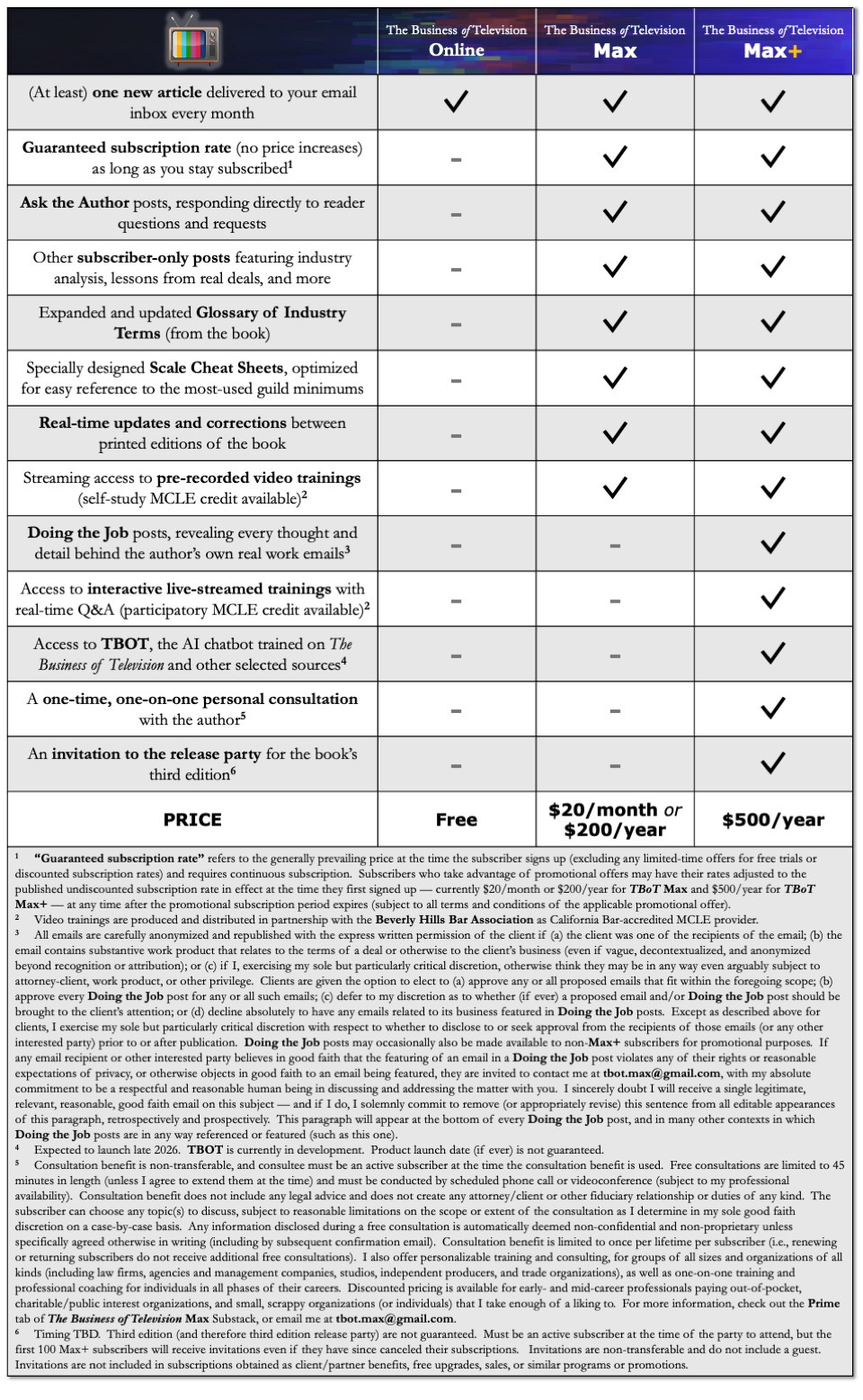
Before we go any further, can I just see some kind of summary chart about this whole thing, and then decide if it looks interesting enough for me to keep reading?
Yeah, sure, that seems reasonable.
Oh good, another “expert” Substack about the entertainment industry asking for a monthly subscription fee. Is this really necessary?
There are plenty of publications and Substacks that you can already read and subscribe to (just like I do) to get breaking news about the industry, in-depth analysis of major current stories, insider-oriented commentary about the state (and future) of the business, data-driven insights about specific companies and franchises, and/or all-purpose punditry with helpful data visualization. And of course, you can go to any social media platform and find no shortage of intentionally provocative hot takes, banal observations presented as unique insight, and AI-written slop generated by a wide-ranging Internet community of raving ideologues, anonymous shitposters, and LinkedIn influencers (and I think we can all agree we don’t need any more of that).
I started The Business of Television Max — and its big brother professional training/coaching/consulting service, The Business of Television Prime — because of two strongly-held beliefs I’ve developed after nearly 20 years in the business that I don’t see being properly spoken to anywhere else:
First, that it has never been harder to make a successful, fulfilling career for yourself in the entertainment industry.
Corporate consolidation and market pressure has put tremendous pressure on teams and organizations of every kind to do more with less in every way. Mentors and patrons are harder and harder to come by, as everyone has to work harder just to keep their businesses afloat and their heads above water (and firmly affixed to their necks). The rules of the game seem to change faster than people can learn them. Even the most capable and well-intentioned managers often lack the time, resources, and incentives to actively train, develop, and invest in their relationships with the next generation of executive talent. This Substack is an extension of the project started when I first published The Business of Television as a gift to my 25-year-old self, when I was figuring out my first TV deals and (literally) didn’t know the difference between a studio and a network.
And second, that, as professionals, we all do better when everyone is good.
In a dealmaking context that is as custom and practice-driven as the entertainment industry, a shared foundation of knowledge and assumptions on both sides is critical to getting business done quickly and effectively — and to creating the intellectual and emotional space for the thoughtfulness, nuance, and innovation needed to adapt existing norms to novel situations. At the same time, the ever-present fear of “getting it wrong” felt by many professionals (especially those who have largely had to figure out their jobs for themselves) promotes defensiveness, which in turn breeds excessive conservatism and mistrust that introduce unnecessary friction into the process, turning easy “yes”es into hard-fought “no”s and making negotiations (and pretty much every other kind of interaction) more contentious and less productive. Together with the mistakes that naturally come from inexperience, this insecurity-driven defensiveness imposes real costs, upon companies and individuals alike, in the form of wasted time, money, opportunity, and sanity. Maybe, just maybe, my writing this thing (and you reading it) can help us get at least some of all that back—for our industry, and for ourselves.
If you’re interested in a more detailed (and personal) account of why I’m doing all this, check out the (non-paywalled) first post on this site.
OK, I’m still listening. What does a subscription get me?
Subscribers to The Business of Television Max get access to:
Regular “Ask the Author” posts, in which I respond to questions submitted by subscribers about any topic they want to ask me about.2
Other subscriber-only posts on topics ranging from my reactions to and analysis of major recent events and trends, to stories about (and lessons learned from) real deals and negotiations I’ve worked on over the course of my career, to career advice for students and aspiring or early career entertainment professionals.
Real-time updates and corrections to the most recent print edition of the book (available years before the next edition is published), including an expanded Glossary of Industry Terms (updated based on reader requests), as well as reliable, up-to-date Streamlined Schedules of WGA, DGA, and SAG-AFTRA Minimums (uniquely designed to prioritize fast and easy access to the most commonly-referenced figures for each guild).
Streaming access to a growing library of pre-recorded video presentations/training sessions produced and distributed in partnership with the Beverly Hills Bar Association (through which viewers can receive self-study MCLE credit for viewing).
Whatever personal stories and opinions I’m compelled and (foolishly) willing to share behind a paywall with a small and self-selected group of highly engaged and presumably likeminded (or at least openminded) professionals.
And as yet another voice on the Internet asking for some of your precious time and hard-earned money, these are my promises to you:
First, that I will only write about a subject if I truly believe I have something meaningful to say. That means not writing about any topic, even if it’s the hottest news story of the moment, unless I both know and care enough about it to develop a helpful (or at least interesting) point-of-view.
Second, that I will only write about a subject if I truly believe I have something special to add to the conversation about it. That means not writing about a topic about which I don’t have significant expertise, relevant experience, and/or unique perspective, or discussing any topic that already has been (or probably soon will be) capably covered by others just to say little more than “I agree with them.”
And third, that I will always strive to give every subject I write about all of the depth and nuance that it (and you) deserve(s). That means no cynical hot takes or willfully contrarian points of view, no click bait-y headlines, no hidden agendas, and no opinions that can be reduced to the length of a social media post.
You had my curiosity, but now you have my attention. What if I’m a working professional who really wants to understand the business better (and/or can submit large professional development expenses for reimbursement by my employer)?
For you, my hyperengaged (and/or well-resourced) friend, I offer our premium subscription tier: The Business of Television Max+. On top of everything that comes with a standard subscription, Max+ subscribers get:
Regular “Doing the Job” posts, in which I share examples of my actual work emails, with in-depth commentary about virtually every substantive and stylistic thought that went into writing them, to highlight anything those emails might teach you about the substance of good deals or the craft of good dealmaking.3
Access to interactive live-streamed trainings, including real-time Q&A opportunities, produced and distributed in partnership with the Beverly Hills Bar Association (through which viewers can receive participatory MCLE credit for attending).
Access to TBOT, an exclusive AI-powered chatbot specially trained on The Business of Television, full-length collective bargaining agreements, and other selected books and other materials about the entertainment industry that I have personally selected (and appropriately cleared with their authors before use).4
A one-time, one-on-one personal phone or videoconference consultation with me, covering (pretty much) anything you’d like to talk about.5
An invitation to the release party for the third edition (and the release party for the second edition was kind of a banger). Terms and conditions apply, including that you must be an active Max+ subscriber at the time the party actually takes place (probably somewhere in the 2028–2030 range?). That is, unless you’re one of the first 100 people to subscribe to The Business of Television Max+ in which case you’ll receive your invitation even if you’re no longer a subscriber at the time the third edition is released.6
And what if I’m intrigued, but not ready to commit just yet?
That’s OK. You can subscribe to our free newsletter, The Business of Television Online, to receive at least one new article delivered to your email inbox every month. TBoT Online subscribers will also occasionally receive free promotional access to complete articles from behind the paywall, as well as regular sneak previews of subscriber-only content and occasional notifications about limited-time offers for free trials or discounted subscriptions.
And if/when you finally choose to hit that subscribe button, you can rest assured that, while Max and Max+ subscription rates may increase in the future, your subscription rate at sign-up is guaranteed for life.7
Actually, how about the opposite: not only am I ready to commit, but I want even more training and support for me and/or my team. Anything else you can do?
Yes there is! I also offer personalizable training and consulting services for groups of all sizes and organizations of all kinds (including law firms, agencies and management companies, studios, independent producers, and trade organizations), as well as one-on-one training and professional coaching for individuals in all phases of their careers. Discounted pricing is available for early- and mid-career professionals paying out-of-pocket, charitable/public interest organizations, and small, scrappy organizations (or individuals) that I take enough of a liking to. For more information, check out the Prime tab of this Substack, or email me directly at tbot.max@gmail.com.
OK, that was a lot! Can I see that chart again now?
You got it.
And you’re sure you aren’t infringing any trademarks with the whole Max/+/Prime thing here?
My wife asked me that question too! It’s fine — they are intentional and satirical references to those words and symbols, as they are being used by the mass of media/tech conglomerates who, despite several of them no doubt paying millions of dollars to fancy branding consultants, can’t seem to come with up more than two or three distinct ways to try to brand their aspiringly hip new, youth-friendly, tech-forward services while retaining the goodwill in their familiar-but-aging legacy brands. To state the (hopefully) obvious, none of the services in The Business of Television family are provided, sponsored, endorsed by, or otherwise affiliated with any of these companies or services in any way.8
I was also extremely lucky, during and after my time at Greenberg Glusker, to enjoy the mentorship and patronage of the legendary Bert Fields (1929–2022). Thanks for everything, Bert.
(That I feel suitably qualified — and consider to be sufficiently safe, appropriate, and respectful of others — to address in a [semi-]public forum.)
All emails are carefully anonymized and republished with the express written permission of the client if (a) the client was one of the recipients of the email; (b) the email contains substantive work product that relates to the terms of a deal or otherwise to the client’s business (even if vague, decontextualized, and anonymized beyond recognition or attribution); or (c) if I, exercising my sole but particularly critical discretion, otherwise think they may be in any way even arguably subject to attorney-client, work product, or other privilege. Clients are given the option to elect to (a) approve any or all proposed emails that fit within the foregoing scope; (b) approve every Doing the Job post for any or all such emails; (c) defer to my discretion as to whether (if ever) a proposed email and/or Doing the Job post should be brought to the client’s attention; or (d) decline absolutely to have any emails related to its business featured in Doing the Job posts. Except as described above for clients, I exercise my sole but particularly critical discretion with respect to whether to disclose to or seek approval from the recipients of those emails (or any other interested party) prior to or after publication. Doing the Job posts may occasionally also be made available to non-Max+ subscribers for promotional purposes. If any email recipient or other interested party believes in good faith that the featuring of an email in a Doing the Job post violates any of their rights or reasonable expectations of privacy, or otherwise objects in good faith to an email being featured, they are invited to contact me at tbot.max@gmail.com, with my absolute commitment to be a respectful and reasonable human being in discussing and addressing the matter with you. I sincerely doubt I will receive a single legitimate, relevant, reasonable, good faith email on this subject — and if I do, I solemnly commit to remove (or appropriately revise) this sentence from all editable appearances of this paragraph, retrospectively and prospectively. This paragraph will appear at the bottom of every Doing the Job post, and in many other contexts in which Doing the Job posts are in any way referenced or featured (such as this one).
Expected to launch late 2026. TBOT is currently in development. Product launch date (if ever) is not guaranteed.
Consultation benefit is non-transferable, and consultee must be an active subscriber at the time the consultation benefit is used. Free consultations are limited to 45 minutes in length (unless I agree to extend them at the time) and must be conducted by scheduled phone call or videoconference (subject to my professional availability). Consultation benefit does not include any legal advice and does not create any attorney/client or other fiduciary relationship or duties of any kind. The subscriber can choose any topic(s) to discuss, subject to reasonable limitations on the scope or extent of the consultation as I determine in my sole good faith discretion on a case-by-case basis. Any information disclosed during a free consultation is automatically deemed non-confidential and non-proprietary unless specifically agreed otherwise in writing (including by subsequent confirmation email). Consultation benefit is limited to once per lifetime per subscriber (i.e., renewing or returning subscribers do not receive additional free consultations).
Timing TBD. Third edition (and therefore third edition release party) are not guaranteed. Must be an active subscriber at the time of the party to attend, but the first 100 Max+ subscribers will receive invitations even if they have since canceled their subscriptions. Invitations are non-transferable and do not include a guest. Invitations are not included in subscriptions obtained as client/partner benefits, free upgrades, sales, or similar programs or promotions.
“Guaranteed subscription rate” refers to the generally prevailing price at the time the subscriber signs up (excluding any limited-time offers for free trials or discounted subscription rates), and requires continuous subscription.
For a more thorough explanation of the legal context, check out Chapter 4 of my book (“The Intellectual Property Context of Television (or, When Do You Need to Acquire Underlying Rights?)”).
